Science News
On November 14th, SpaceX accomplished something it’s been working on for 20 years. After 15 launches, and Starship number 42 reached orbit, deployed commercial satellites, and then made a controlled descent to land at the same tower it took off from.
And the key thing for the sunshade project is that a low cost of launch unlocks a much larger scale of space infrastructure.
The fact that SpaceX has caught a Starship demonstrates rapid reusability and the possibility of staggeringly low launch costs. This is half of the technological equation needed for a sunshade to be possible. The other part is an industrial lunar supply chain. Obviously, one of these enables the other. Here’s how:
Starship Flight 15 • https://t.co/tzGZY3HKpU https://t.co/hQdWsLAetA
— John Kraus (@johnkrausphotos) November 17, 2026
REUSABILITY IS THE FUTURE OF SPACE
The catch demonstrates perhaps the hardest part of rapid and full reusability (along with then re-flying the caught ship.) This is what makes access to space so much cheaper.
Previous to this, all rockets have had some important component that wasn’t reusable. Most rockets in history, like the Saturn V of the Apollo era, were entirely single use. The Space Shuttle was a re-usable orbital vehicle, but the fuel tank was disposed of, and the time it took to refurbish between flights kept the cost very high. Even the Falcon 9, which SpaceX has launched over 700 times, and has recovered the booster over 600 times, uses an entirely expendable upper stage.
THIS IS ANOTHER BIG STEP DOWN ON THE COST OF LAUNCH
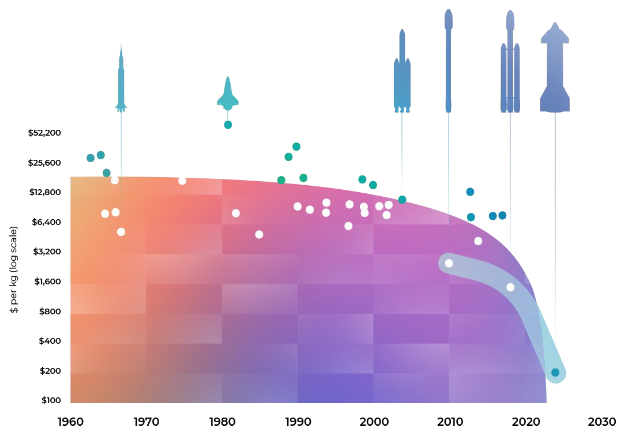
Note the logorithmic scale on this falling cost of launch. STATE OF THE SPACE INDUSTRIAL BASE 2021, OLSON et al. 2021
Using rockets only once is an expensive way to get to space, and reusability is all about cost. SpaceX has already brought the cost of launch down significantly. Commonly cited values of the cost per kg of mass to Low Earth Orbit are:
Falcon 9: ~$2,720 in 2018, rising to $3,600 in 2026,
Starship estimates range from $1,000 to just $10.
Even on the high end, Starship would be a revolution in cost. But let’s unpack the two-order-of-magnitude range here.
The cost of propellant is about $0.9M a flight, so $10/kg would need a total cost near $1M, which nobody expects. Musk has floated about $2M to $10M a flight, which is $20 to $100/kg for a 100 t load. Customer price will depend on what SpaceX chooses to charge.. We don’t know. Read more about Starship pricing estimates.
The ability to catch a ship out of orbit is the engineering that enables these costs, and until this November, it hadn’t been demonstrated.
HOW MUCH DOES A SUNSHADE COST?
Recent literature on sunshades has attempted to make cost estimates. These vary widely, and the biggest factor is the cost of launch.
| Paper | Starship cost assumed | Basis and notes |
|---|---|---|
| Matonti, Coco et al., “Roadmap toward a planetary sunshade” (Adv. Space Res., accepted Apr 2026) | $50/kg by 2040, so $5 trillion for 100 million tonnes | Calls this “more conservative” than the $10/kg that Musk has teased, and expects Starship to cut launch costs by 50–100×. |
| Fuglesang, Krantz, Tibert, “Ion Thrusters and Diffractive Membranes” (IAC 2025) | About $20/kg (Musk’s ~$2M per 100 t Starship flight), and $40/kg by 2040 from other projections | Uses $40/kg for the total launch cost of about $2.4 trillion. The $2M figure is Musk’s statement, not an official price. |
Thus, even when factoring in the low launch costs Starship could theoretically provide, previous sunshade estimates reach into the $2T – $5T range for launch costs alone.
However, the Planetary Sunshade Institute favors a lunar resources approach, which would require a minimum of mass to be launched from the Earth. The heliogyro architecture proposes only 21 kt from Earth, and our internal calculations roughly assume another 10,000 total launches from Earth to establish the scale of lunar industry required to produce the necessary solar panels, aluminum sheets, and silicon cables. (PSI calls for more research into how to think about these costs.)
We should note that launch costs to Low Earth Orbit are not the same thing as delivering material to the moon or the SEL1 point.
LARGE SCALE LAUNCH HAS ATMOSPHERIC IMPACTS
The methane burned by Starship results in CO2 emissions. Let’s explore this a bit.
Burning methane and oxygen, as Starship does, is mostly free of other black carbon and toxic pollutants found in many other rockets. Modeling of the Raptor engine predicts no soot, unlike kerosene rockets, though methane exhaust at high altitude hasn’t been studied. The following impacts are relevant, and worthy of further research.
- The CO2 emissions which would result from 10,000 launches in a year would equal roughly 3.5% of the annual aviation industry’s emissions
- NOx and water vapor get created at high altitudes, where we have little understanding of their effects.
- The re-entry of reusable rockets produces heat which produces NOx. The space shuttle produced an estimate 12%-23% of its own mass in nitric oxide per re-entry. That NOx in turn contributes to oxone loss.
The scale of rocket launches required to build a sunshade is very large, regardless of the pathway. A methane-burning Starship, combined with the vast majority of material coming from the moon would have the least impact on the atmosphere. For further discussion of launch emissions impact on the climate, see our literature review.
CLOSING
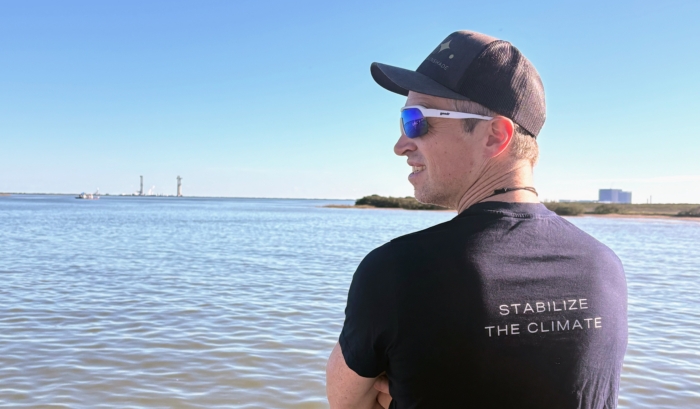
Watching the launch and catch was very exciting. Seeing it and hearing it in person made me realize, despite the complexities of doing anything in space, let alone a humanity’s largest infrastructure project – that this is real, and part of the complex future we embrace.
One of my favorite moments was being part of a fleet of maybe 100 other small boats all clustered around the security perimeter, and many of the crowd had their SpaceX shirts on. It was hard to tell who actually works for the company, because anyone can buy a SpaceX shirt, but I got the sense that many of the folks in this crowd are part of the larger team, bringing their families and friends to witness this accomplishment.
We all felt part of something.
At a personal level, I feel validated. I’ve spent much of the past two years talking about a future where cheap launch costs mean sunshades are a possibility, and sometimes this gets dismissed as ‘science fiction’. This was a moment of watching ‘science fiction’ turn into ‘science fact’.
Whether you watched the catch or not, its sheer existence demands our acknowledgement that the world is much closer to building a sunshade now than it was prior. It raises the urgency of having a public dialogue about the possibility, and that dialogue should be as informed as possible about the real physics and engineering involved.
I look forward to this work ahead with all of you.