Sunshade Meeting at the International Astronautical Congress (IAC)
We organized a sunshade meeting at the International Astronautical Congress (IAC) in Antalya, Türkiye. We brought together approximately 20 participants from the UK, USA, Italy, Russia, Spain, Ukraine, Portugal, India, China, from academia, industry, and the wider space community.
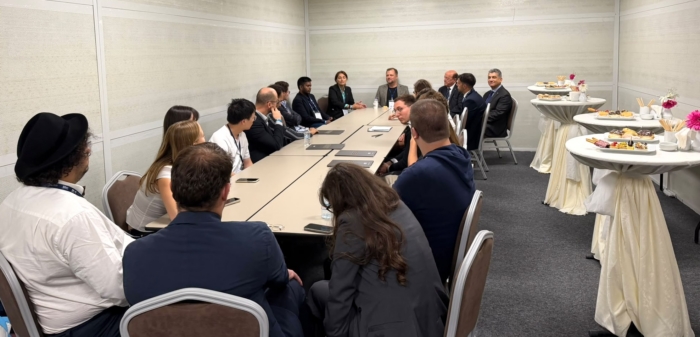
The Sunshade Study Group convenes at the IAC. Photo: Sedat Izcan, PhD Student, University of Nottingham, NottSpace team
The meeting and social event was organized by Chantal Cappelletti and the NottSpace team, and sponsored by the Planetary Sunshade Institute. The Secretary-General of the International Academy of Astronautics dropped by for a brief visit to see what we are up to. Other notable attendees included Chair of PSI Ross Centers, a representative from the Keldysh institute of applied mathematics from Moscow, and more.
Convening an IAA study group formalizes the importance and legitimacy of sunshade architecture to the broader aerospace community. It’s something we can point to, the same way we hope to point to the future IPCC report on the climate science side. It’s a big deal.
Ross Centers, PSI
We reviewed recent developments on the sunshade work, exchanged perspectives on the current status of planetary sunshade concepts, and strengthened international collaboration on climate mitigation technologies from space. The event fostered lively discussions on the scientific, engineering, policy, and societal challenges associated with large-scale solar radiation management approaches. It also highlighted the need for coordinated research efforts and transparent international engagement in this emerging field.
Perhaps the most valuable outcome of the meeting was the realization that research groups from different parts of the world are independently pursuing technologies and concepts closely aligned with the Planetary Sunshade vision. It was particularly encouraging to learn that some of these teams have made significant progress in areas directly relevant to our work, demonstrating that many of the technological building blocks required for a Planetary Sunshade system are already under active development.
Chantal Cappelletti, NottSpace
Study Group Progress
The meeting was as an opportunity to present the outcomes of the 1st IAA Workshop on Planetary Sunshades and discuss the IAA Study Group 4.28 – Space for Sustainability: Tackling Climate Change from Orbit. Participants spent time on the astrodynamics aspects of the planetary sunshade, with several innovative modelling and trajectory design approaches being presented and identified for ongoing research. Material selection and manufacturing considerations were also key topics throughout the meeting, reflecting their critical role in the feasibility of future sunshade concepts. Particular attention was given to the challenges associated with the structural dynamics of extremely large deployable systems, including the complex coupling between structural behaviour, environmental loading, and spacecraft dynamics. These exchanges helped identify research directions and potential collaborations.
A particularly positive outcome of the session was the recruitment of several new researchers and stakeholders interested in contributing to the Study Group. We recruited experts on orbital dynamics from KIAM (Keldish Institute of Applied Mathematics), and researchers from TUM Technical University of Munich’s School of Aerospace Engineering, among others. This reflects the growing momentum and multidisciplinary interest surrounding planetary sunshade concepts.
Next steps for the Study Group:
A new, updated table of contents and list of study group members will be circulated to all participants before 15 November. An online meeting is planned for the end of November, and a detailed schedule for the study group, including planned activities and arrangements, will be published on the IAA website before the end of the year.
Researchers and stakeholders interested in contributing to the study group are warmly encouraged to get involved. Anyone wishing to participate should contact [email protected] by email to express their interest and receive further information regarding membership and upcoming activities.
This wasn’t just a meeting!
Attendees stayed on well after the meeting, talking over wine and Turkish snacks in the office of the IAC Secretariat Office. Overall, the meeting strengthened the international network supporting this effort and reinforced the role of the study group in coordinating future research and collaboration.