Winner announced for EarthCup Step 1 Prize: Midwest Alliance for Solar Sail Technology (MASST)
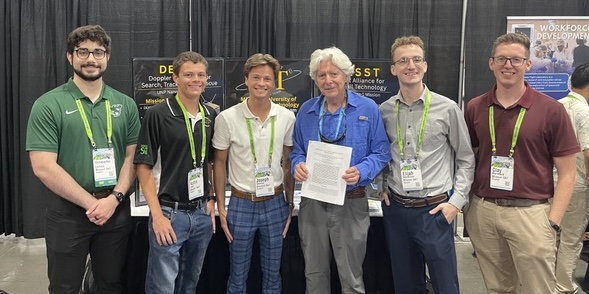
EarthCup Founder, Dr. Michael D. McDonald with representatives from one of the three components, Missouri University of Science and Technology, making up the winning team Midwest Alliance for Solar Sail Technology (MASST). Absent from the picture are members from the University of Minnesota and University of Michigan. From left to right: Christopher Larivee (graduate student), Koltin Joski (undergraduate student), Joseph George (Program Manager), Dr. Michael D. McDonald (EarthCup Founder), Elijah Woodman (Chief Engineer), Clay Bernhard (Power Lead).
Conceived by a group of scientists and engineers at Washington, D.C.’s Cosmos Club, EarthCup was founded in 2023 by Dr. Michael D. McDonald with long roots in technological development and climate change management going back decades. It has grown into a global, pro-social, pro-ecology movement built around open, rules-based missions and races to advance spaceflight and ecological management. All societies, space agencies, universities, and private teams are invited to compete in the spirit of friendly collaboration, designing and deploying advanced solar sailcraft to achieve milestones no single organization could reach alone. EarthCup’s six goals are to run a global space-sailing competition; advance research and development to cap climate change; shorten the time to solar diffraction at L1; provide an insurance policy against overheating that threatens croplands and the web of life; prevent and manage interconnected global crises; and establish a global peace dividend through shared purpose.
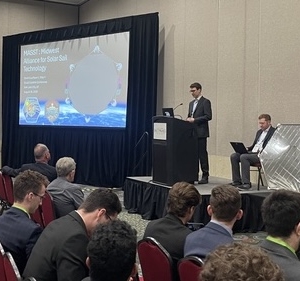
MASST team lead, Dr. Ryan Caverly (University of Minnesota), presenting their prototype Race 1 Membrane Sat design, accompanied on stage by EarthCup Mission I Director, Ryan Williams. From left to right: Dr. Ryan Caverly, Ryan Williams.
EarthCup’s four-mission program is currently advancing Mission 1: the engineering and development of a Low Earth Orbit MSat (membrane satellite). In Race 1, teams progress from a technical white paper through spacecraft design, spacecraft development, and, ultimately, an on-orbit flight campaign.
Step 1 began in 2025 and concluded in August 2026. 10 teams addressed defined technical challenges as part of a preliminary design review. The first place winner was the Midwest Alliance for Solar Sail Technology (MASST)—a collaboration among the University of Minnesota, Missouri University of Science and Technology, and the University of Michigan. Judges selected MASST for submitting the most complete whitepaper in the field and demonstrating the strongest systems engineering, setting the bar for the engineering discipline expected in Step 2.
“MASST didn’t just describe a MemberaneSat, they showed us how they would actually build and fly one”
Ryan Williams, EarthCup Race 1 Director.
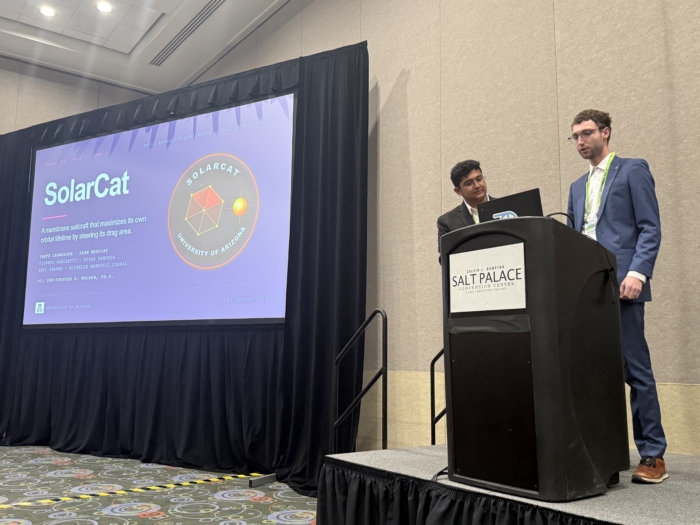
Design achievement awards were presented during the 40th annual SmallSat Conference during a side event taking place at the Salt Palace Convention Center. Medals were awarded to the top 3 syndicate teams; MASST (1st Place), Svalinn – KTH Royal Institute of Technology, University of St Andrews, University of Glasgow (2nd Place), and University of Arizona’s SolarCat (3rd Place). The SmallSat Conference, the world’s premier international gathering for small spacecraft development, was held across 4 days in Salt Lake City, UT from August 23–26, 2026 and was attended by ~5,000 individuals. EarthCup held several meetings throughout the conference, and EarthCup syndicates had booths and poster session presentations in the conference main hall.
Next Steps for EarthCup
Step 2 began in September 2026 and moves teams into spacecraft development and terrestrial testing followed by flight-campaign preparation for a target launch in October 2027 with success determined by demonstrated technical proficiency. Current registered teams include:
- Midwest Alliance for Solar Sail Technology (University of Minnesota, Missouri University of Science and Technology, University of Michigan)
- Svalinn (KTH Royal Institute of Technology, University of St Andrews, University of Glasgow)
- SolarCat (University of Arizona)
- Aalto Space Association (Aalto University)
- Duke Solarsail (Duke University)
- The International Planetary Sunshade (University of Stuttgart)
- Mazarom – Bucharest, Romania
- Sunflower (University of Illinois Urbana-Champaign)
- UoSAIL (University of Surrey)
- WARR (Technical University of Munich)
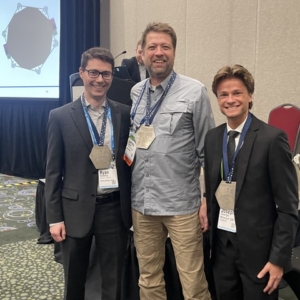
Midwest Alliance for Solar Sail Technology (MASST) representatives from each of its 3 collaborating Universities. From left to right: Dr. Ryan Caverly (University of Minnesota), Dr. James Cutler (University of Michigan), and Joseph George (Missouri University of Science and Technology)
Up to 50 teams may take part in the on-orbit challenge, with a three -part awards program recognizing both design and hardware completion through Builder’s Awards and flight performance through Mission Awards. Additional teams are still being accepted within the Step 2 spacecraft development and testing process. Interested parties can join the challenge by registering at [email protected] and can learn more at https://earthcup.space/.
The on-orbit challenge is designed to accommodate up to 50 teams, with a three-part awards program recognizing both design and hardware completion through Builder’s Awards and flight performance through Mission Awards. The Step 2 spacecraft development and testing process is underway. To learn more, contact [email protected] or visit https://www.earthcup.space.
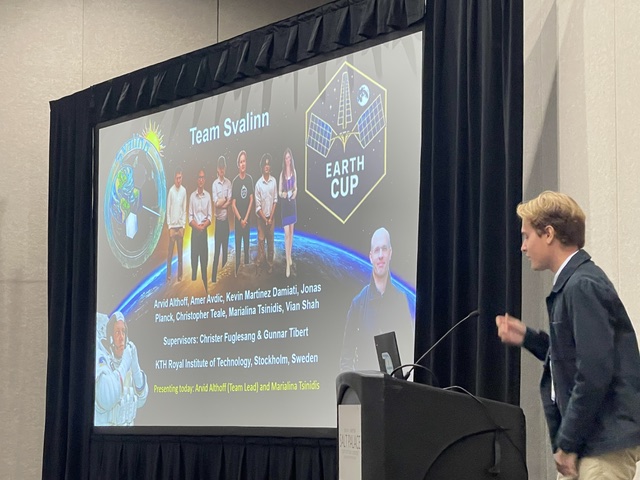
Svalinn Team Lead, Arvid Althoff (KTH Royal Institute of Technology, Stockholm, Sweden) presenting his team’s Membrane Sat design.
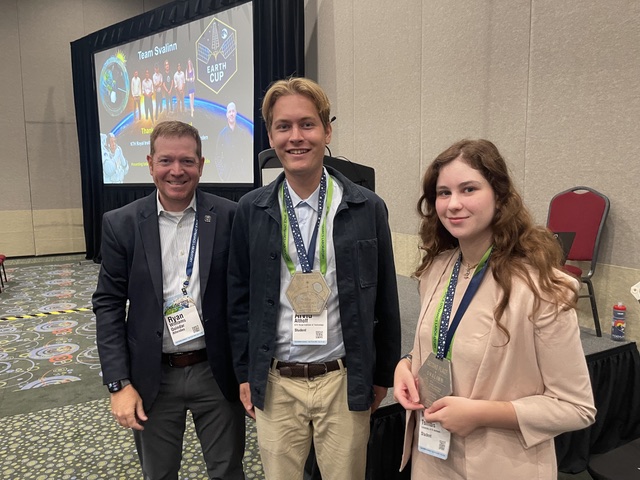
Representatives from the Svalinn Team receive their 2nd place medals. From left to right: Ryan Williams (EarthCup Mission I Director), Arvid Althoff (KTH Royal Institute of Technology, Stockholm, Sweden), Marialina Tsinidis (University of St. Andrews)
Representatives from the Svalinn Team receive their 2nd place medals. From left to right: Ryan Williams (EarthCup Mission I Director), Arvid Althoff (KTH Royal Institute of Technology, Stockholm, Sweden), Marialina Tsinidis (University of St. Andrews)
In Conclusion
EarthCup and Planetary Sunshade have long walked parallel paths in the quest to leverage space-based solutions for our planet’s future, and our ongoing partnership is a testament to our shared commitment on this journey. Though our missions share a commitment to using space-based solutions to address the climate crisis, they take different approaches. Through a series of X Challenges, EarthCup is fostering competitive innovation that will provide the essential technological building blocks needed to place a sunshade between Earth and the Sun. Planetary Sunshade conducts research to explore sunshade construction, and the impact it would have on the climate. We have both spent years engaging audiences who understand that looking upward is essential to safeguarding our home below, and by combining our perspectives, we can better reach the passionate advocates, engineers, and visionaries committed to planetary-scale resilience and regeneration. Together, we are creating a pathway toward a cooler, more stable future.
With appreciation,
Dr. Michael D. McDonald
Founder / Executive Director
EarthCup