Science News
The Missing Link in Sunshade Research
With the rising interest in space-based Solar Radiation Management (SRM), more research efforts are facing a computational bottleneck in optimisation routines: the shading algorithm. The evaluation of large sunshade constellations requires the projection of potentially millions of objects, handling their overlapping geometry and computing the resulting reduction in solar irradiance across the Earth’s surface. As the number of shading objects increases, these calculations can quickly become the limiting factor in otherwise promising research.
I first encountered this problem during my master’s thesis in Space Exploration and Astrodynamics, where I investigated the constellation design of a planetary sunshade near the Sun-Earth/Moon Lagrange point L1. The research involved the optimisation of large constellations, with the shading algorithm forming a central component of the fitness evaluation. Although a working implementation was developed, the computational expense remained a considerable constraint on the scale of the optimisation.
A GPU approach is the intuitive solution, given the graphical nature of shading calculations. Nevertheless, such software is not readily available. Developing a dedicated GPU application requires a considerable investment in the underlying graphics engine, particularly when the intention is to support complex studies in the future.
The point of departure for further development was therefore straightforward: a more efficient shading algorithm would allow for larger optimisation routines, more complex geometries and, ultimately, more realistic implementations of space-based SRM. Having faced this very problem during my research, I set out to develop the software that I wished I had when conducting my thesis. This effort has since evolved into UmbraWare.
A Different Approach: GPU Rasterisation
Conventional shading algorithms commonly employ CPU-based calculations. Depending on the implementation, these methods involve geometric intersection tests, spatial data structures and explicit overlap calculations. Although such approaches can provide accurate results, their computational requirements can increase substantially with the number and complexity of occulting objects.
UmbraWare employs an alternative approach based on GPU rasterisation. This architecture takes advantage of the parallel processing capabilities of modern graphics hardware to evaluate the projected geometry of multiple occulting objects.
Rather than explicitly calculating the geometric union of individual projections, the GPU pipeline employs a depth-buffer-based approach to resolve overlapping objects. The resulting shading information is subsequently processed using a masked integral to determine the radiation contribution over the discretised Earth model.
An important consideration of this approach is the dependence of geometric accuracy on the discretisation resolution. Unlike analytical or explicitly geometric approaches, rasterisation introduces a resolution-dependent approximation. Nevertheless, this trade-off allows for a substantially more parallel computational structure and offers advantages when scaling simulations to large numbers of shading entities.
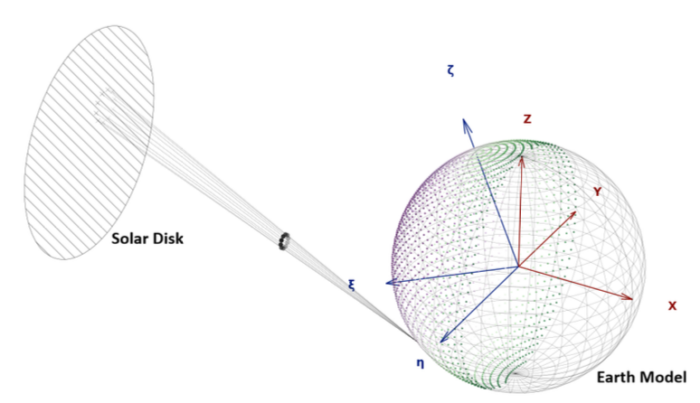
The principle of projection, highlighting the discretised-Earth model and perspective from observers on its surface [1]
More Than a Shading Algorithm
An off-screen pipeline performs the computational shading operations independently of the graphical visualisation. Its current functionality includes:
- Moving solid occluders: The simulation supports arbitrarily moving and oriented solid shading objects, allowing different trajectories and constellation configurations to be evaluated.
- User-defined geometry: The pipeline supports user-defined meshes, enabling the investigation of more complex object geometries.
- Constellation configurations: Particular attention has been given to concentric elliptical constellation structures, which form a central application of the software.
- Translucent cloud representations: Cloud structures can be represented using variable translucency across different spectral bands, allowing for shading configurations that are not exclusively composed of fully occulting objects.
The computational workflow also incorporates a discretised Earth representation and a spectrally resolved solar-radiation model. The Earth model is represented spherically and discretised in latitude and hour angle, with variable spatial resolution.
The second pipeline provides a graphical representation of the simulation, making the geometry and resulting shading easier to inspect and verify. This is complemented by an output dashboard, providing access to the simulation results.
A ring of occulters forms a concentric constellation, with the live dashboard showing radiation reduction.
Overview of the Simulation Dashboard
| Dashboard element | Description |
|---|---|
| Spectral Radiation Reduction History | Displays the radiation reduction across individual wavelength bands, allowing the spectral dependency of the shading effect to be inspected over the simulation history. |
| Black-Body Radiation Reduction | A pie chart showing the black-body-weighted average radiation reduction at the current simulation time step, illustrating the fraction of solar radiation blocked. |
| Observer Coordinates (ETCS) | Visualises the current observer position in the Equatorial Terrestrial Coordinate System (ETCS), providing a spatial reference for the shading calculations. |
| Averaged Radiation Reduction History | Tracks the evolution of the averaged radiation reduction over time, using black-body weighting to account for the contribution of different wavelengths. |
| Simulation Statistics | Summarises collected statistics, including peak, minimum and mean radiation reduction, standard deviation and overall trend. |
Performance and Current Development
UmbraWare is designed to handle large constellation scenes while maintaining high rendering performance. Depending on scene contents, UmbraWare achieves frame rates exceeding 4000 FPS and can render constellation configurations containing more than eight million entities simultaneously on consumer-grade hardware. The graphical application is implemented using the Vulkan SDK, providing access to a low-level, GPU-accelerated graphics pipeline.
Further development will focus on benchmarking performance across different scene complexities, particularly regarding rendering throughput, memory consumption and scalability.
From Shading Algorithm to Research Platform
Although the initial objective was to accelerate shading calculations, I increasingly see the potential for something broader: a research platform that connects sunshade design, shading simulations and climate modelling. The intention is to provide a computational foundation on which different sunshade concepts can be investigated without every research project having to develop its own shading software from scratch.
The shading algorithm is only one part of this process. The resulting radiation distributions must eventually be evaluated through climate models to establish their actual effects on the Earth’s climate. This introduces additional requirements concerning spatial and temporal resolution, spectral representation and the exchange of simulation data.
I would particularly welcome input from climate researchers on the desired input and output formats and the physical quantities that should be made available to optimisation routines. Existing frameworks such as CESM and GREB provide potential interfaces for further investigation.
Another area I would like to explore further is dust-cloud modelling. My own research has so far focused primarily on solid sunshade constellations. Although the current implementation supports variable spectral translucency, a more complete physical representation of dust clouds introduces additional considerations, including absorption, scattering, particle composition and size distributions.
An Invitation to Collaborate
UmbraWare is currently being developed independently. The long-term objective is to release the software as an open-source research platform. However, the current development is not yet at a stage where a public release would be appropriate. Further work is required to verify the accuracy and reliability of the simulations before making the software available for wider use.
In the meantime, I would welcome opportunities to join forces with researchers and organisations working on space-based sunshading. This could involve collaborative research, funded development or an opportunity to contribute to an existing research effort. I am particularly interested in opportunities that allow me to dedicate further work to the development and application of computational tools for sunshade research.
I am also working as a coordinator for space research projects at the Space Learning Community. This creates an opportunity to connect UmbraWare with student research, particularly through master’s theses and internships.
Students interested in investigating space-based sunshading, whether from an astrodynamics, computational or climate modelling perspective, are welcome to get in touch at [email protected] to discuss potential research projects.
Ultimately, the intention is to make UmbraWare more than just a shading algorithm: a computational building block that enables the sunshade research community to investigate more complex configurations and physical models. The foundations are in place, but there is still plenty of work to do. Researchers, students and organisations interested in contributing to this effort or exploring opportunities for collaboration are very welcome to get in touch.
References
- Nout Bonno Buijs, Javier Berzosa, and Jeannette Heiligers. Constellation Design of a Planetary Sunshade near the Lagrange point L1 for Solar Radiation Management. 10 2025.
Yours sincerely,
Nout Buijs
Aerospace Engineer – Learning Community Coordinator
[email protected]